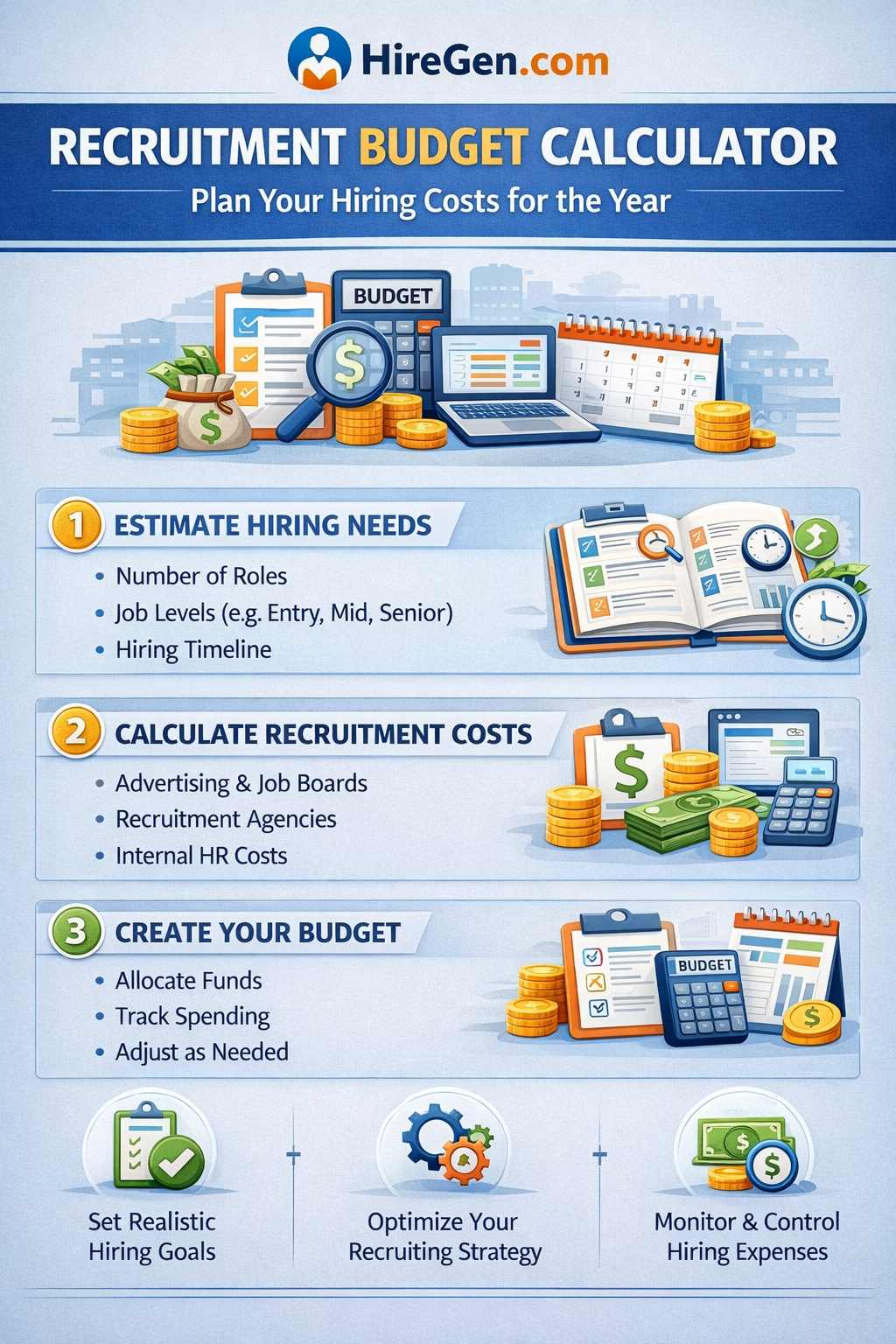
Recruitment Budget Calculator: Plan Your Hiring Costs for the Year
Build your complete annual recruiting budget in minutes. Enter your headcount plan, role levels, and salary targets — get a full cost breakdown with channel allocation and industry benchmarks.
✍ By HireGen HR Team
· Updated Jan 2025
· 14 min read
· ⭐ 4.8/5 (1,830 uses)
⚡ Quick Answer
A recruitment budget is the total planned spend to hire all approved headcount for a given period, covering external sourcing (job boards, agencies), internal costs (recruiter salaries, ATS), employer branding, and onboarding. Most companies budget 5–15% of new-hire total compensation on recruiting costs. The average US cost per hire is $4,700 (SHRM), making a 50-hire plan roughly a $235,000 base recruiting budget before fixed costs.
Add each role type you're planning to hire this year. The calculator builds your complete annual budget with channel breakdowns and quarterly pacing.
Step 1 — Add Your Planned Hires by Role
Step 2 — Fixed Annual Recruiting Costs
Recruiter Salaries (total/yr)
$
ATS / Recruiting Software
$
Employer Brand / Careers Page
$
Career Fairs & Events
$
Background Check Platform
$
Contingency Buffer (%)
Step 3 — Quarterly Hiring Distribution (%)
Q1 %
Q2 %
Q3 %
Q4 %
Your Annual Recruitment Budget
Total Annual Budget
—
incl. fixed costs & contingency
Variable Hiring Costs
—
per-hire external + internal
Fixed Annual Costs
—
salaries, ATS, brand, events
Total Planned Hires
—
Blended Cost Per Hire
—
vs. $4,700 US average
Contingency Reserve
—
Recommended Budget Allocation by Channel
Quarterly Budget Pacing
What Is a Recruitment Budget?
A recruitment budget is the planned annual spend allocated to attract, assess, and hire candidates across your organization. It encompasses every cost involved in filling open positions — from the first job posting to the signed offer letter — plus the fixed infrastructure costs that support the recruiting function year-round.
Unlike a simple per-hire cost estimate, a proper recruitment budget is a strategic financial plan that aligns talent acquisition spending with your organization's headcount goals, growth targets, and business priorities for the year ahead.
Organizations that build structured recruitment budgets consistently achieve:
Better vendor negotiations — annual commitments with job boards and tools yield better rates
More accurate forecasting — finance and HR alignment reduces mid-year surprises
Stronger ROI measurement — channel allocation enables source-of-hire ROI tracking
What to Include in Your Recruitment Budget
A complete recruitment budget covers four major categories of spend. Missing any one of these leads to budget overruns and frustrated hiring managers.
1. External Sourcing Costs (Variable)
These are direct out-of-pocket costs paid per hire or per posting:
Job board subscriptions and postings — Indeed, LinkedIn, ZipRecruiter, Glassdoor, and niche boards
Staffing agency and headhunter fees — typically 15–25% of first-year salary per placement
Pre-employment background checks and drug screening
Skills assessments and personality testing tools
Candidate travel and interview expenses — for senior or remote candidates
Relocation packages — especially for senior, specialized, or geographic-constraint hires
2. Internal Recruiting Infrastructure (Fixed)
Fixed annual costs that power your recruiting function regardless of hire volume:
Recruiter and TA team salaries and benefits — often the largest single line item
Applicant Tracking System (ATS) — Greenhouse, Lever, Workday, etc.
AI sourcing and recruiting tools — platforms like HireGen that automate candidate discovery
HRIS and HR tech stack — allocate recruiting-related portion
Employee referral program administration
3. Employer Brand & Marketing
Often underfunded, employer branding has an outsized ROI impact:
Careers page design and content
Glassdoor and Indeed employer profile management
LinkedIn Talent Brand products
Social media content and paid social recruiting ads
Video content — employee testimonials, culture videos
4. Events and Campus Recruiting
Career fairs — booth fees, travel, materials
University and campus recruiting programs
Industry conferences with talent acquisition objectives
Virtual recruiting events and webinars
💡
Don't forget the 15–20% contingency buffer. Unplanned hires (backfills, new headcount approved mid-year) and hard-to-fill roles that exceed estimates are nearly universal. Budget without a buffer consistently leads to mid-year shortfalls and rushed, expensive hiring decisions.
How to Build Your Recruitment Budget: 6 Steps
Step 1
Finalize Your Annual Headcount Plan
Work with finance and business leaders to lock in the approved headcount plan: total hires, role levels, departments, and target start quarters. This is your budget's foundation — everything else is derived from it.
Step 2
Assign Cost Per Hire Estimates by Role Level
Use SHRM benchmarks and your own historical data to estimate cost per hire for each role type: entry-level ($1,500–$3,000), mid-level ($4,000–$8,000), senior ($8,000–$15,000), executive ($28,000+). Adjust upward for hard-to-fill or specialized roles.
Step 3
Calculate Fixed Annual Infrastructure Costs
Add all fixed costs: total recruiter team compensation (salaries + benefits + overhead), ATS and HR technology, employer brand investments, and career events. These are independent of hire volume.
Step 4
Allocate Budget by Sourcing Channel
Divide external budget across channels based on your hiring mix. Rule of thumb: job boards 25–35%, agencies 30–40%, employer brand 15–20%, assessments/background 5–10%, events 5–10%.
Step 5
Add Quarterly Pacing
Distribute hiring across quarters to match business cycles and manager availability. Most companies follow a front-loaded pattern (higher Q1/Q2) or back-loaded pattern depending on fiscal year budget releases.
Step 6
Add Contingency and Benchmark
Apply a 15–20% contingency buffer to your total variable costs. Then benchmark total budget as % of planned total compensation: target 5–15% depending on growth stage and industry.
Recruitment Budget Benchmarks by Company Size & Industry (2025)
How much should your organization budget for recruiting? Industry data points to clear norms, though growth stage and talent market competitiveness are the dominant variables.
Budget as % of New Hire Total Compensation
Scenario
Budget % of Comp
Typical CPH
Agency Reliance
Label
Stable enterprise, low turnover
5–8%
$3,000–$5,000
Low
Efficient
Mid-market, moderate growth
8–12%
$4,700–$8,000
Medium
Average
High-growth startup (Series A–C)
12–18%
$7,000–$14,000
High
Growth
Executive-heavy hiring
18–30%
$25,000–$80,000
Very High
Premium
High-volume hourly workforce
3–7%
$1,000–$3,000
Minimal
Volume
Typical Channel Budget Allocation
Here's how leading talent acquisition teams allocate external recruiting budget across sourcing channels:
Trend to Watch: Forward-thinking TA teams are shifting budget from agencies (historically 35–45%) toward AI sourcing technology and employer brand. Companies using tools like HireGen report reducing agency spend by 40–60% while maintaining hire quality — reinvesting those savings into higher recruiter-to-hire ratios and better candidate experience.
Recruitment Budget by Company Growth Stage
Your growth stage fundamentally shapes what a "good" recruiting budget looks like. Here's how to think about it:
Stage
Annual Hires
Recruiter Model
Typical Budget
Key Cost Driver
Pre-Series A
1–20
Founder-led + 1 recruiter
$50K–$150K
Agency fees for senior hires
Series A/B
20–80
2–5 in-house recruiters
$200K–$600K
Recruiter salaries + job boards
Series C+/Growth
80–300
Full TA team + coordinators
$600K–$2M+
Team cost + brand investment
Mid-Market (500–2K employees)
50–200
In-house TA team
$400K–$1.5M
ATS, brand, selective agencies
Enterprise (2K+ employees)
200–2,000+
TA CoE + RPO
$1.5M–$20M+
TA team cost + RPO contracts
5 Strategies to Optimize Your Recruitment Budget
1. Shift Spend from Agencies to Technology
Agency fees (15–25% per placement) are the highest-cost, lowest-scalability channel in most recruiting budgets. Investing in AI sourcing platforms and strong in-house recruiters delivers the same pipeline quality at a fraction of the cost. Every dollar moved from agency fees to AI sourcing tools typically yields 3–5x more candidate volume.
2. Build an Employee Referral Program as a Budget Line
Referral bonuses ($1,000–$5,000 per hire) appear expensive on a line-item basis but reduce total cost per hire by 40–60% through lower sourcing costs and higher conversion rates. Budget for referrals explicitly — not as an afterthought — and track referral CPH as your cheapest channel.
3. Front-Load Employer Brand Investment
Employer brand spending compounds over time: Glassdoor content, LinkedIn presence, and a well-designed careers page reduce inbound sourcing costs every subsequent year. Companies with a strong employer brand see a 50% reduction in cost per hire over 2–3 years of consistent investment, per LinkedIn data.
4. Use Data to Kill Low-ROI Channels
Most organizations spend on 5–8 sourcing channels but get 80% of quality hires from 2–3. Use your ATS to track cost per quality application and offer acceptance rate by source. Eliminate the bottom half and reallocate to high performers.
5. Build Talent Pipelines for Recurring Roles
Reactive hiring — posting only when a role opens — is the most expensive pattern. For roles you hire repeatedly (engineers, sales reps, customer success), invest in always-on sourcing pipelines so you have warm candidates ready before urgency sets in, eliminating the pressure to pay premium agency fees.
Frequently Asked Questions
How much should a company budget for recruitment?
+
Most companies budget 5–15% of new-hire total compensation on recruiting. At the SHRM average cost per hire of $4,700, a company planning 50 hires has a variable recruiting spend of ~$235,000 — plus fixed annual costs (recruiter salaries, ATS) and a 15–20% contingency buffer. High-growth companies and those in competitive talent markets trend toward 10–15%.
What should be included in a recruitment budget?
+
A complete recruitment budget includes: (1) External sourcing — job board fees, agency fees, background checks, assessments, advertising. (2) Internal fixed costs — recruiter salaries and benefits, ATS/HR technology, employer branding. (3) Events — career fairs, campus recruiting, industry conferences. (4) Referral bonuses — included as an internal recruiting cost. (5) Contingency buffer — 15–20% for unplanned hires and overruns.
What percentage of payroll should be spent on recruitment?
+
Industry benchmarks suggest 5–15% of planned new-hire total compensation. Stable organizations with low turnover trend toward 5–8%. High-growth companies in competitive talent markets (tech, healthcare) trend toward 10–15%. Executive-heavy hiring can push this to 20%+ due to search firm retainers.
How do you create a recruitment budget from scratch?
+
Six steps: (1) Finalize your headcount plan. (2) Assign cost-per-hire estimates by role level using SHRM benchmarks. (3) Calculate fixed annual costs (recruiter salaries, ATS, brand). (4) Allocate external budget by channel. (5) Add quarterly pacing. (6) Add a 15–20% contingency buffer and benchmark against industry norms. Use our calculator above to do this in minutes.
How much does an in-house recruiter cost per year?
+
A US in-house recruiter costs $65,000–$110,000 in base salary plus 20–30% for benefits and overhead, totaling $78,000–$143,000 annually. A senior technical recruiter or talent acquisition manager costs $100,000–$160,000+ fully loaded. Each in-house recruiter typically handles 15–50 hires per year depending on role complexity.
What is a typical split between job boards and agencies?
Hard-to-fill roles should be budgeted at 1.5–3x the standard cost per hire for that level. Factor in: extended time-to-fill (60–120 days vs. 30–45), higher likelihood of agency use (15–25% of salary), relocation assistance for geographic constraints, and additional recruiter hours. Building proactive talent pipelines for recurring difficult roles reduces these costs significantly.
Should employee referral bonuses be in the recruitment budget?
+
Yes — referral bonuses ($1,000–$5,000 for most roles, up to $10,000+ for technical/leadership roles) should be an explicit budget line. Despite the cost, referred hires typically have 40–60% lower total cost per hire, faster time-to-fill, and significantly higher 1-year retention rates — making referrals consistently the highest-ROI sourcing channel.
How does company growth stage affect recruiting budget?
+
Growth stage is a major driver: Early-stage startups typically spend 15–25% of new-hire comp on recruiting due to high agency reliance and limited brand. Growth-stage companies (Series B–C) spend 10–15%. Mature enterprises in stable hiring mode spend 5–10%. Companies in high-turnover markets or entering new geographies should budget at the higher end regardless of stage.
Related HR Calculators & Resources
💰
Cost Per Hire Calculator
Calculate your true cost per hire using the SHRM formula, with internal, external, and onboarding costs.
🔄
Cost of Turnover Calculator
Quantify the true financial cost of employee attrition to make the ROI case for retention investment.
⏱️
Time to Fill Calculator
Track and benchmark time-to-fill by role and department against industry averages.
📈
Recruiting ROI Calculator
Measure the return on your full recruiting investment by channel, tool, and team.
📋
Headcount Planning Template
Free annual headcount plan template aligned to budget cycles and finance requirements.
🎯
Sourcing Channel ROI Tool
Compare cost per quality application and hire rate across all your sourcing channels.
HireGen's AI sourcing engine automates candidate discovery across 30+ channels — reducing agency dependency and recruiter hours per hire. Plans from $299/month.