A talent map answers three questions before you start searching: where these people work, roughly how many exist, and what it would cost to move one. It turns searching from an activity into a plan.
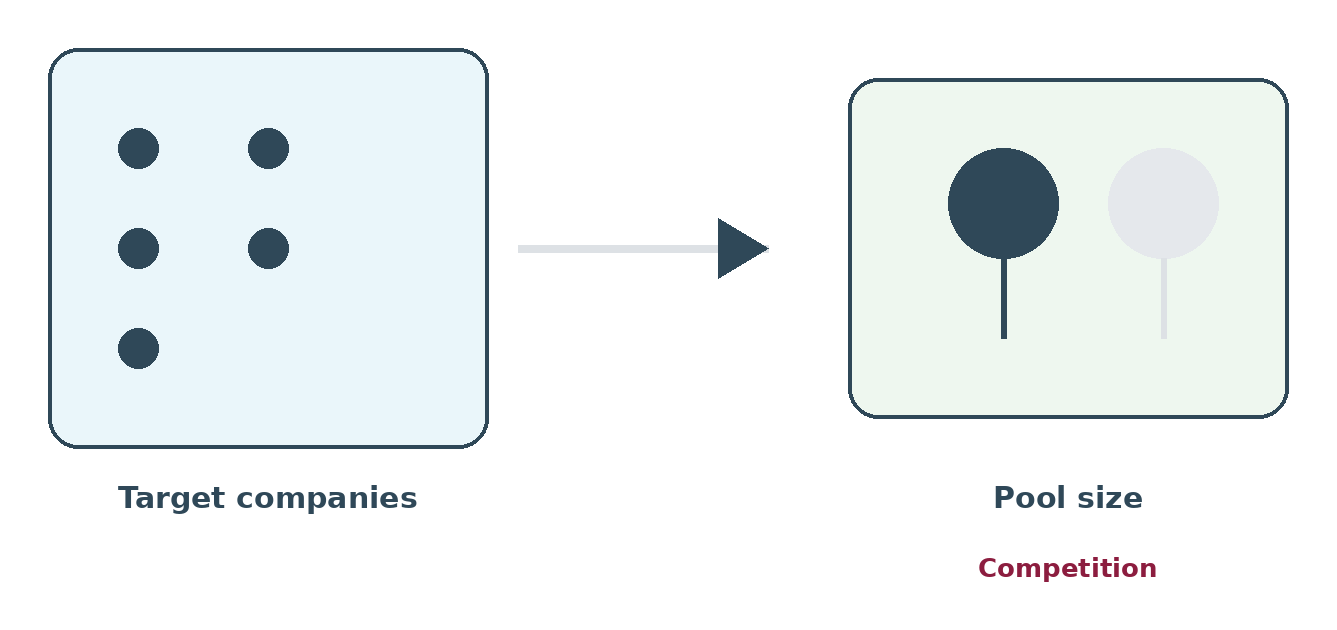
What goes in it
| Part | What you write down | What you use it for |
|---|---|---|
| Target companies | Competitors, related industries, places people come from | Aiming your searches, prompting referrals |
| How many exist | A rough count by area and seniority | Setting expectations, and knowing if the search is possible |
| Jobs people hold before this one | Titles they move from | Widening your search, finding people ready to step up |
| Salary range | From live job adverts and salary surveys | Your offer, and the conversation about your own range |
| Where the density is | Which areas actually have these people | Remote policy, whether an office-based search is realistic |
| Who else is hiring | Live adverts for the same job | Predicting reply rates and how fast you must move |
Building one
- Start with three to five companies you know produce this kind of person. Ask the hiring manager — intake question 7 exists for this.
- Work outwards. Other industries with the same problem, consultancies serving the sector, and companies one size smaller where people are ready to step up.
- Count. Run your search for each area and note the number of results. Treat these as rough. Result counts are estimates, they change between runs, and they include duplicates and dead profiles. The difference between 90 and 900 is what you need. The difference between 90 and 110 is nothing.
- Check the money. Collect published ranges from live adverts for the same job in the same place. Adverts understate the top of the range and are still the most current free information you will get.
- See who else is buying. Count live adverts for the same job. Heavy competition changes your reply rates and your timeline, and it is worth knowing before you promise anything.
Two conversations it gives you
With yourself: where to spend your hours. If 70% of the people sit in four companies, your approach is very different from a pool spread across two hundred.
With the hiring manager: this is the document that makes a hard conversation easy.
"The person you described exists in about 130 people within commuting distance, and six companies are hiring for it right now at a higher salary than ours."
That is not pessimism. It is a market report. It turns an argument about difficulty into a decision about requirements, budget or location.
What a map is not
Precise. Every number in it is an estimate built from public information with known gaps. Present it that way — ranges, not exact figures. The moment someone treats your rough count as a real number, they will hold you to it.
Maps last
A map for a type of job stays roughly true for six to twelve months, and updating one takes a fraction of building it. If you hire the same kind of person repeatedly, this is the highest-value thing in the module.